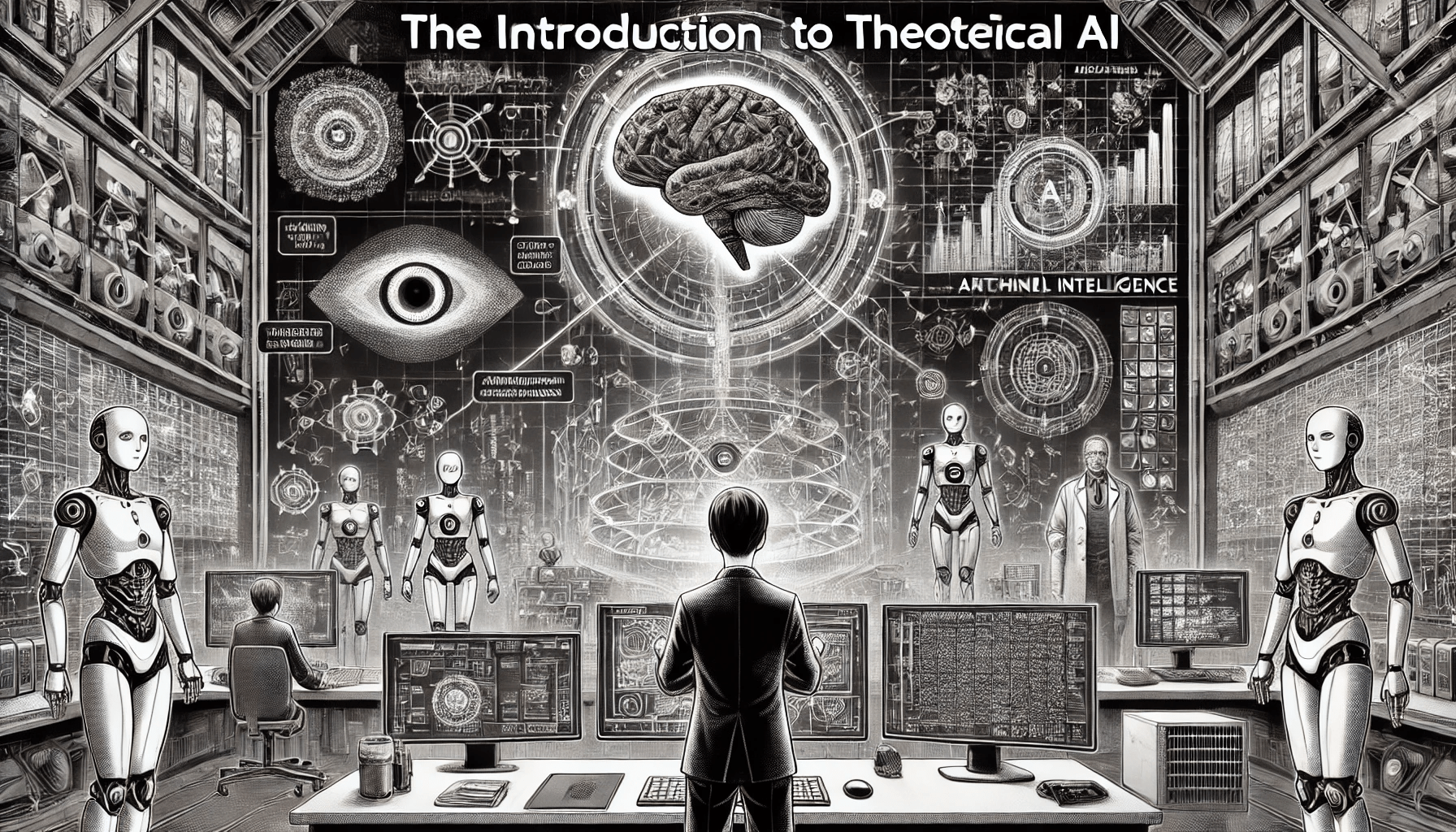
# Introduction to Theoretical Foundations of AI
Artificial Intelligence is built on a foundation of theoretical principles that define how machines learn, reason, and solve problems. Theoretical AI focuses on the mathematical and logical frameworks that guide the development of intelligent systems. By understanding these foundations, we can create AI that is more efficient, adaptable, and capable of handling complex tasks.
Introduction to Theoretical Foundations of AI
### What is Theoretical AI?
Theoretical AI explores the fundamental questions of intelligence—both human and artificial. It involves developing algorithms, models, and formal methods that allow machines to process information, make decisions, and learn from data. Unlike applied AI, which focuses on real-world applications, theoretical AI provides the blueprint for building smarter and more reliable systems.
### Historical Evolution
The study of AI has evolved over decades, beginning with early symbolic reasoning in the 1950s, where logic-based approaches dominated. In the 1980s, expert systems and rule-based AI gained popularity, followed by breakthroughs in machine learning in the 2000s. Today, deep learning and neural networks have revolutionized AI, but theoretical research continues to refine these models, improving their efficiency and understanding their limitations.
### Key Theoretical Concepts
Theoretical AI is grounded in several core concepts. **Search algorithms** help AI navigate problem spaces efficiently, while **knowledge representation** enables machines to store and process information. **Uncertainty and probabilistic reasoning** allow AI to make informed decisions even with incomplete data. **Optimization techniques** improve performance, ensuring AI systems function effectively in dynamic environments.
By studying these principles, we gain deeper insights into AI’s capabilities and constraints. This chapter provides the foundation for exploring advanced AI topics, equipping you with the knowledge needed to understand and develop intelligent systems.
---
# Agent Instructions: Querying This Documentation
If you need additional information that is not directly available in this page, you can query the documentation dynamically by asking a question.
Perform an HTTP GET request on the current page URL with the `ask` query parameter:
```
GET https://apphp.gitbook.io/artificial-intelligence-with-php/artificial-intelligence/theoretical-foundations-of-ai/introduction-to-theoretical-foundations-of-ai.md?ask=
```
The question should be specific, self-contained, and written in natural language.
The response will contain a direct answer to the question and relevant excerpts and sources from the documentation.
Use this mechanism when the answer is not explicitly present in the current page, you need clarification or additional context, or you want to retrieve related documentation sections.