# Reinforcement Learning
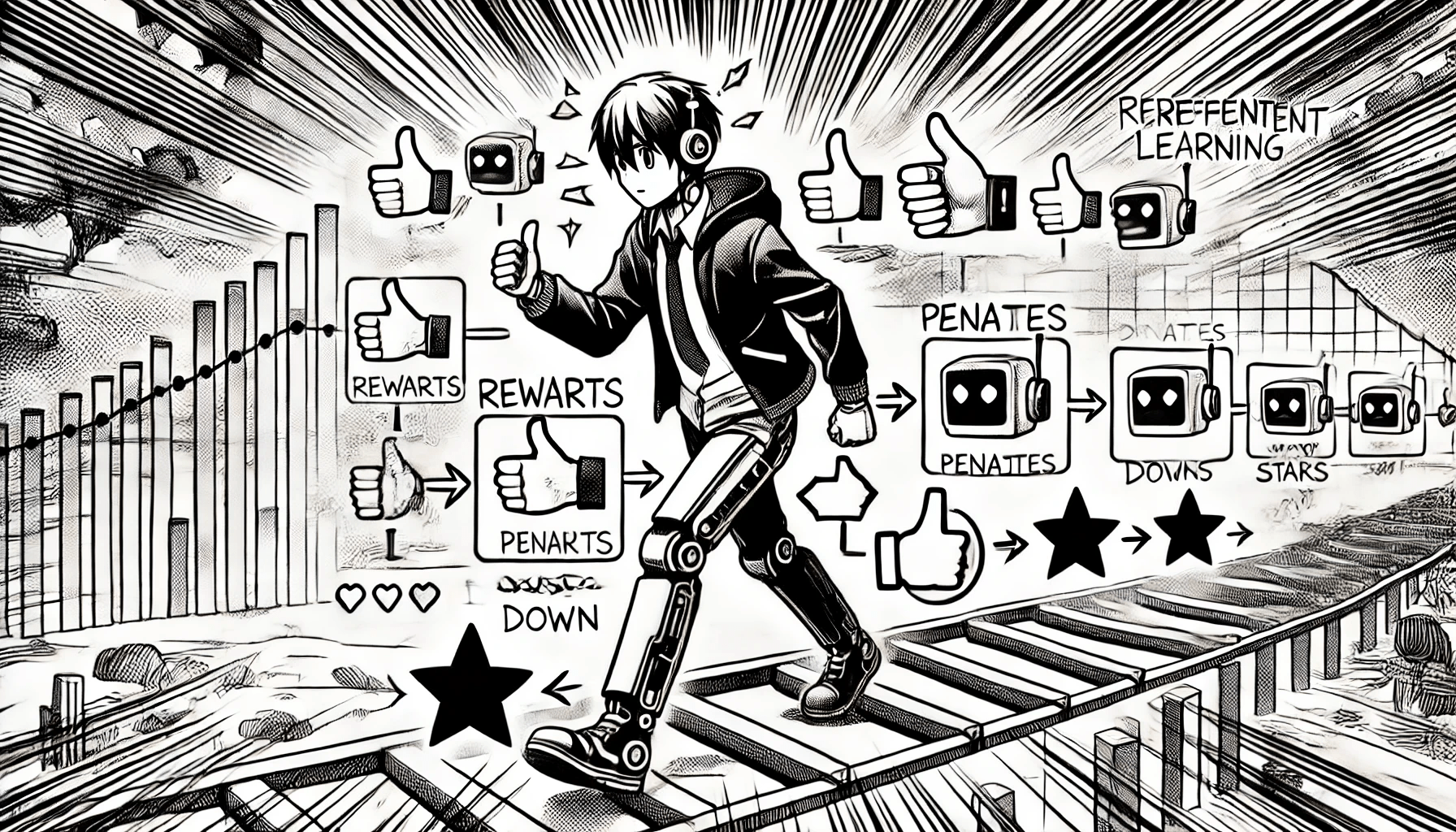
Reinforcement learning (RL) involves an agent that interacts with an environment and learns to make decisions by receiving feedback in the form of rewards or penalties. The agent’s objective is to maximize cumulative rewards over time. This technique is widely used in game AI, robotics, and autonomous systems.
Reinforcement Learning
### Reinforcement Learning
Algorithms that learn through interactions with an environment, using rewards or penalties to improve behavior.
* Q-Learning
* SARSA (State-Action-Reward-State-Action)
* Deep Q-Networks (DQN)
* Policy Gradients
* Proximal Policy Optimization (PPO)
* Bayesian Q-Learning. (tasks: Optimal Decision-Making, Handling Uncertainty, Exploration vs. Exploitation, Adaptation to Changes )
* (In-context Reinforcement Learning
---
# Agent Instructions: Querying This Documentation
If you need additional information that is not directly available in this page, you can query the documentation dynamically by asking a question.
Perform an HTTP GET request on the current page URL with the `ask` query parameter:
```
GET https://apphp.gitbook.io/artificial-intelligence-with-php/machine-learning/ml-algorithms/reinforcement-learning.md?ask=
```
The question should be specific, self-contained, and written in natural language.
The response will contain a direct answer to the question and relevant excerpts and sources from the documentation.
Use this mechanism when the answer is not explicitly present in the current page, you need clarification or additional context, or you want to retrieve related documentation sections.